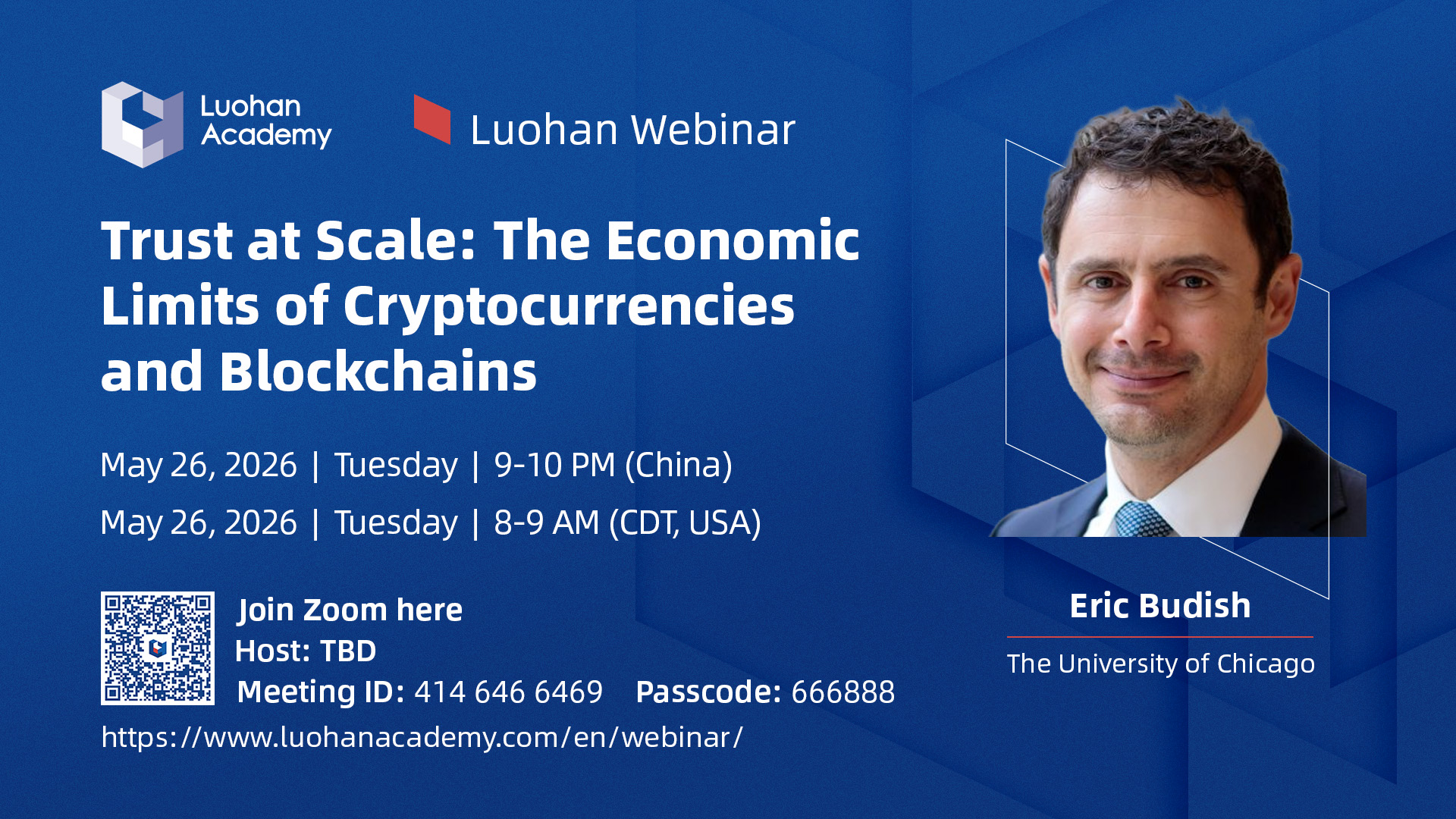
Eric Budish is the Paul G. McDermott Professor of Economics and Entrepreneurship at the University of Chicago, Booth School of Business. He is also a Research Associate at the National Bureau of Economic Research, Co-Director of the Clark Center for Global Markets at Chicago Booth, and Co-Director of the Chicago Booth Economics PhD Program. Professor Budish’s research focuses on market design, with applications ranging from financial exchanges and matching markets to cryptocurrencies, patents, and COVID-19 economic policy.
Abstract
Satoshi Nakamoto (2008) invented a new kind of economic system that does not need the support of government or rule of law. Trust and security instead arise from a combination of cryptography and economic incentives, all in a completely anonymous and decentralized system. This article shows that Nakamoto’s novel form of trust, while undeniably ingenious, is deeply economically limited. The core argument is three equations. A zero-profit condition on the quantity of honest blockchain “trust support” (work, stake, etc.) and an incentive-compatibility condition on the system’s security against majority attack (the Achilles heel of all forms of permissionless consensus) together imply an equilibrium constraint, which says that the “flow” cost of blockchain trust has to be large at all times relative to the benefits of attacking the system. This is extremely expensive relative to traditional forms of trust and scales linearly with the value of attack. In scenarios that represent Nakamoto trust becoming a more significant part of the global financial system, the cost of trust would exceed global GDP. Nakamoto trust would become more attractive if an attacker lost the stock value of their capital in addition to paying the flow cost of attack, but this requires either collapse of the system (hardly reassuring) or external support from rule of law. The key difference between Nakamoto trust and traditional trust grounded in rule of law and complementary sources, such as reputations, relationships, and collateral, is economies of scale: society or a firm pays a fixed cost to enjoy trust over a large quantity of economic activity at low or zero marginal cost.
If you would like to give a presentation in a future webinar, contact our Senior Economist Dr. Wen Chen (wen.chen@luohanacademy.com). For other inquiries, please contact: events@luohanacademy.com.